Search

Behind '88: The Untold Story of a Revolution'
1987 was bleak. My home life was depressing, I was a deeply unhappy teenager. I went to one of the top-performing girls’ schools in the country, where there was an intense psychological pressure on us to get perfect A’s, at the expense of our personal growth and wellbeing. The political landscape was Thatcherism; miners’ strikes, football hooliganism, and the threat of a When the Wind Blows nuclear button press happening at any minute.
We used to sneak out at night, lying to our parents as to our whereabouts, telling them we were staying at a friend’s house, some of us literally climbing out of bedroom windows to avoid detection, and enter the exotic underground world of London nightlife, presided over by the likes of Philip Sallon, Boy George and Leigh Bowery. We got into all the clubs easily – worryingly in retrospect. We thought we got in because we were cool; looking back, it’s more likely that it’s simply that we were underage girls.
It was thrilling, being exposed to something so radically subversive from the cultural norm of the day. It was exciting seeking out the people and the places where you felt the electricity of doing something that was pushing boundaries. But the scene was still very constrained in its own way: there was a certain dress code, a lot of hairspray and make-up involved, uncomfortable outfits and no smiling allowed. Bored, disinterested, aloof, above it all – that was the energy you were supposed to give off in the Mud and the Wag.
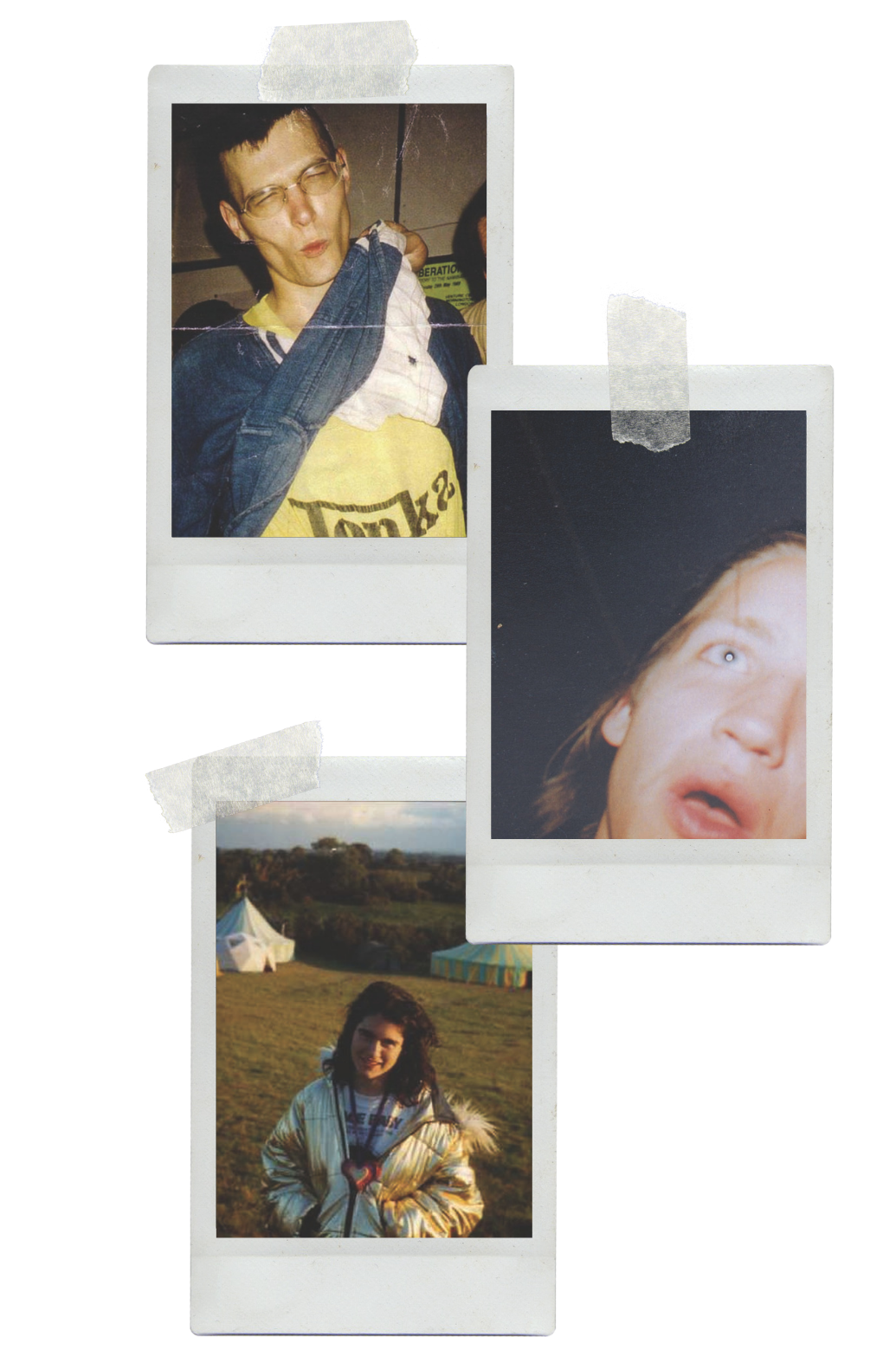
The first time I went to an acid house club was Nicky Holloway’s Trip at the Astoria. We didn’t get into the Mud that night and the Trip was next door, so in we piled. My memory is that I was the only person in the room in a skirt. Dungarees and Kickers were the order of the day, and we all did that weird rocking dance that no-one has ever been able to explain to me why we did that.
Everything changed for me at that point. I left home, left school, and moved into a squat in Camberwell. I took the lyrics of the songs I heard to heart, “Someday We Will All Be Free,” “Brothers, Sisters, We Will Make It to the Promised Land,” “Living Together in Sweet Harmony.” I ditched the hairspray and frown, and embraced the smiley face and love & peace attitude. In my teenage naivety, I genuinely believed that we were entering a new age of unity, and we were going to live together as one family, dancing in fields and being free, respecting each other and the earth, for happily ever after.

Well, you don’t need me to tell you that it didn’t work out like that. Some people made careers out of that time, and exported our culture out of the community and into the rest of the world. Some got into heavy drugs and there were many overdoses. Too many ended up institutionalised, either in psychiatric wards or in prison. The parties became overrun with criminals, and ruined by repeated police brutality.
Where did that leave little me? I had nothing to fall back on. I had immersed myself in the world of squats and raves, and I had no family to go back to, no job that I had left behind. All I had were my newfound Bohemian values, and a passion for dancing until dawn. As it all fell apart around me, people dying, moving away, getting locked up, or going “back to normal,” I refused to believe that it had all been a drugged-up delusion. It had seemed real to me. Understandably, people didn’t want to talk about it. Either they were becoming materially comfortable and they wanted to distance themselves from the messy underbelly; or they were too mashed up to begin to reflect and make sense of it all.
I spent the next twenty years wondering, what happened? How did I turn from a spiky-haired moody punk to a loved-up smiley hippy chick, and why? Were we crazy to believe that by dancing in a field we were changing the world, because that’s really what it felt like? I went to University and did a degree in English and Philosophy, got married, had three kids, got divorced, set up a business, had my first three books published, and in 2007 decided to write a book on this pivotal period in my life in an attempt to make sense of it all.
My main motivation was therapy. I wanted to understand what happened, because to be honest, I couldn’t remember most of it. By talking to other people who were there – London, 1987–1992, were my chosen parameters, beginning with Shoom and ending with Castlemorton – I wanted to piece together the narrative and try to resolve my own unanswered questions. Initially, I contacted friends, and got put into contact with friends of friends. I messaged people on MySpace (this was before even Facebook). I wanted to speak with a wide variety of people, and not just the usual suspects – I wanted the ravers, the hippies, the travellers and the clubbers to tell me their story. The real people who lived it and didn’t make careers out of it, but found themselves at the centre of it one way or another. How did it feel to be there? And how did it change their lives, both tangibly and intangibly?
I travelled around London with a voice recorder (this was before smartphones), diligently transcribing interviews, and then cutting them up thematically. Just this process alone took three years. By 2010, I was ready to send proposals to publishers, but depressingly, no-one was interested. In those few years, a few books and documentaries had started to come out around Twenty Years of Acid House, and ironically people told me that the story had been told. What I perceived at that point was a whitewashing of the narrative. Here is your sanitised version, packaged up with a bow of corporate respectability. Four white guys went to Ibiza, and invented Acid House. Now they are Radio One DJs and accepted into the culture, so pay half your week’s salary to get into Ministry of Sound, drink alcopops and pop a pill, that’s OK, as long as you go back to work on Monday.

This wasn’t my story. My story was messy, complicated, and still untold. My story involved bad trips and living in squats with no electricity and friends ending up in prison. My story involved challenging the whole basis of the way we lived our lives and hoping, dreaming, for something different, something better. There was a lot of darkness I saw edited out of the prevailing narrative, in order to make the story more palatable; but equally, a lot of light, in terms of the spiritual frameworks that I adopted from that period, that were just as missing from the versions the big name DJs had to tell. My manuscript stayed on the shelf, gathering virtual dust. In the intervening years, people came into my life at different points and persuaded me not to give up on it – shout out to Ben Cherrill, Max Gates and Paul Martin. But still, no-one wanted to breathe life into it and make it a physical reality.
By 2024, I found myself in the fortunate position of having the financial resources to back it myself. In the true spirit of rave, I saw that, of course, it needed to be a DIY project. I have written and edited it entirely myself, co-designed it with Simon Earl with artwork by Mark Wigan, and self-published it. As proud as I am for having made it this far, I now find myself in the newly depressing position of trying to get it out into the world at a time when virtually all artists are experiencing the struggles of the current commercial set-up. Couple the fact that we have more choice where to spend our money than ever, with the reality that the majority currently has less disposable income to splash around than ever, and the result is that even the most talented creatives among us are challenged to find ways to make a comfortable living from their art.

I have spent thousands of hours and thousands of pounds on this book, but at this stage, I don’t even know what I want from it anymore. It’s been such a mountain to climb to even get it out into the world, and I’m coming to realise that this is an integral part of the story in itself. I will not make money from it, that’s pretty certain. It was never about me, I don’t need to make any personal gain from this. It’s just a story that wants to be told, and I believe it’s such an important story. I believe within it lies a lot of answers to the current issues we face. How something that is at its essence inherently radical and counter-cultural has been adopted into the mainstream and thus co-opted, weakened, and diluted. It’s an examination of how movements grow and evolve and change that we can all learn from.
In writing the book, it fascinated me that, in interviewing nearly 100 people who were all in the same place at the same time, everyone had a uniquely individual story to tell. I guess that’s maybe what I would want for the book itself. That everyone reading it takes something different, but whatever they take, it inspires them to live closer to those 1988 Summer of Love values of “A Happy Face, A Thumping Bass, For A Loving Race.”
You can purchase '88 – A Revolutionary Rave Story' now on Bandcamp, Amazon and visit the book website for more information.
Follow us on Instagram
Keep up to date on all things CDR

120-124 Curtain Road, London, England, EC2A 3SQ
CDR CIC, company number: 12000586


Since we started back in 2001, CDR has been all about community, creating spaces for people to connect and develop through music.
Back in the Plastic People days, you could fit all of us in one small room around one soundsystem. Today, our projects and programmes extend from the dancefloor to schools, youth centres, as well as grassroots clubs and venues across the country and further afield. But in challenging times, with grassroots organisations like ours closing all around us, every bit of support counts.
Your help will enable us to continue delivering music programmes and events in the UK to the people who need it most. Our mission is simple: to build an equitable music ecosystem for producers and artists.
If you have any questions or want to support in other ways please contact us at support-us@createdefinerelease.com
Thank you